


 Fuel Guard
As logistics operations grow in scale, one of the most critical areas requiring effective management becomes fuel security. Especially in fleets with a high number of vehicles, fuel losses that may initially seem minor can gradually turn into serious cost differences over time.
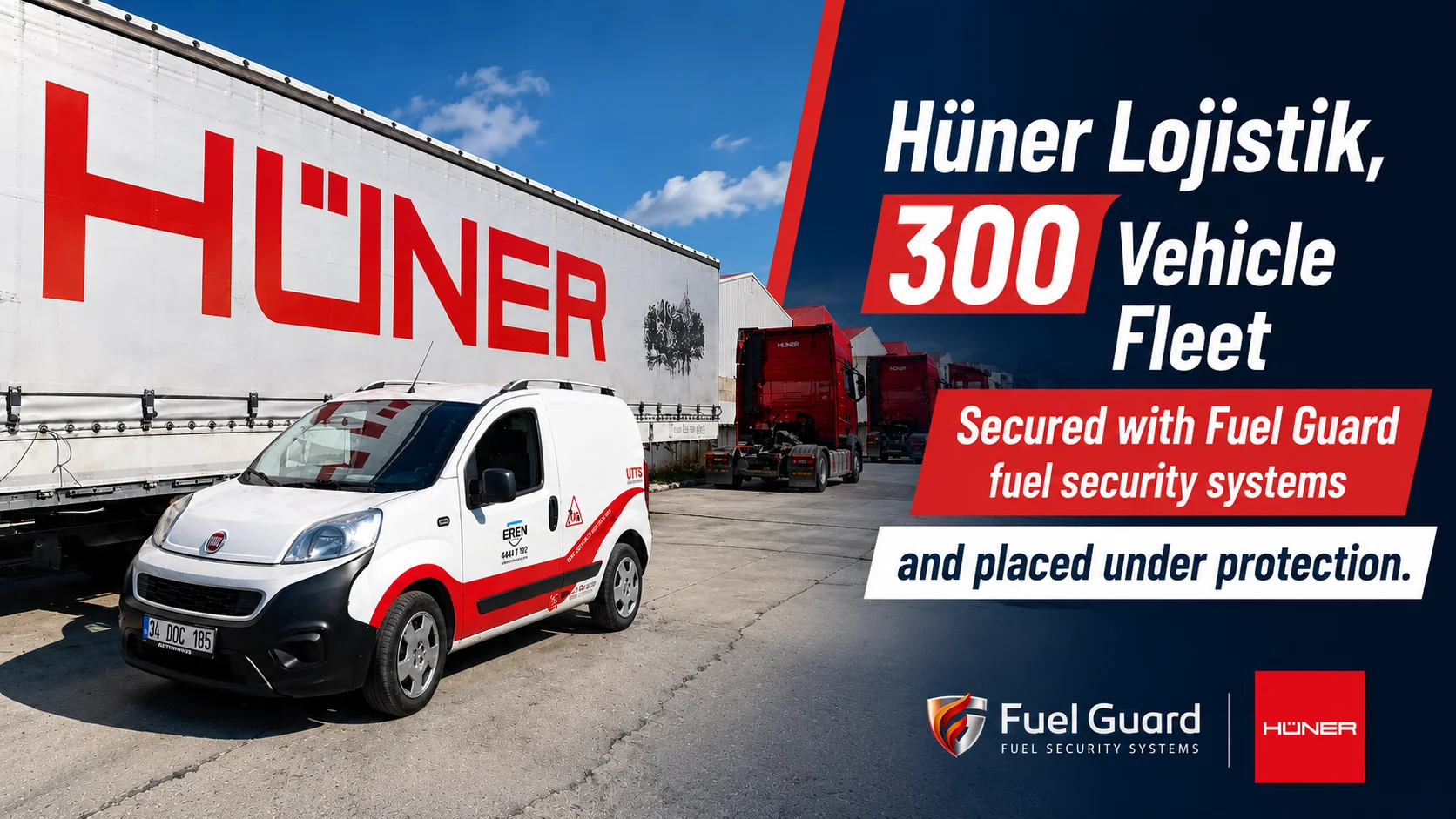
Within this scope, the installation process of Fuel Guard fuel security systems has been completed for 300 Volvo trucks operating in the Hüner Logistics fleet. With this implementation, the fuel security infrastructure across the entire fleet has been standardized, and risks related to fuel theft have been brought under a controllable structure.
Making Fuel Loss Management More Controllable
In the logistics sector, fuel loss is often not caused by a single major incident, but rather by small interventions that are difficult to detect over time. This situation is one of the most important factors making cost control more difficult, especially in large fleets.
At this point, the Fuel Guard fuel security system comes into play with its structure that physically prevents unauthorized access to the fuel tank. The system is designed not to detect fuel loss after it occurs, but to prevent the loss before it can even happen.
Thanks to this approach, both the risk of fuel theft has been prevented and a more predictable fuel consumption structure has been achieved throughout the fleet.
Transition to a Standardized Security Structure Across the Fleet
Production and installation processes were planned without interrupting vehicle operations and were completed seamlessly in the field.
The resulting structure is not a short-term intervention; it is a permanent system established for long-term fuel control and operational security.
Operational Efficiency and Cost Management
Ensuring fuel security is not only a protection mechanism, but also a factor that directly affects cost management. After the implementation, fuel consumption data could be analyzed more accurately, enabling clearer decision-making in fleet management.
Especially in large fleets, eliminating uncontrolled fuel losses provides measurable improvements in total operational costs. For this reason, fuel security applications play a critical role not only in terms of security, but also in terms of financial sustainability.
Integrated Management of Production and Installation Processes
One of the greatest advantages of Fuel Guard diesel security systems is that both the production and installation processes are managed within the same organizational structure.
Thanks to this approach, the system has evolved from being a theoretical solution into a field-tested and proven application with real-world results.
The 300-vehicle Fuel Guard fuel security system implementation carried out for the Hüner Logistics fleet clearly demonstrates how fuel security can be effectively managed through proper planning and the right system.
With this project, fuel tank security has been standardized across the fleet, the risk of fuel theft has been made preventable, and operational cost control has been strengthened.
The outcome clearly shows that fuel security applications are no longer an optional preference in the logistics sector, but a fundamental part of operational efficiency.
Who is Hüner Logistics?
Hüner Logistics is a logistics company operating throughout Türkiye in the field of heavy-duty transportation, particularly standing out with its high-volume cargo operations. The company provides domestic transportation services for various industries and continues its operations with a large vehicle fleet.
Due to its operational structure, the company actively takes part in long-distance transportation, industrial shipments, and projects requiring continuous logistics flow, while adopting an operational approach focused on continuity and efficiency in fleet management.
As the company’s vehicle capacity expanded over time, fuel security — one of the most critical aspects of fleet management — became increasingly strategic.
Why Did Fuel Security Become Critical?
In the logistics sector, fuel is one of the largest components of total operational costs. Especially in fleet operations, these costs are affected not only by consumption, but also by uncontrolled fuel losses.
A similar need emerged within Hüner Logistics. As the fleet structure expanded, fuel management became more difficult to control, while fuel theft and field-related losses started to create operational risks.
At this stage, the goal was not only to monitor fuel, but to establish a system capable of completely preventing fuel loss.
Why Fuel Guard Fuel Security Systems Were Preferred
The primary reason Fuel Guard fuel security systems were preferred in the Hüner Logistics fleet is the system’s ability to provide direct physical protection for the fuel tank.
While many solutions on the market are based only on fuel monitoring and reporting, the Fuel Guard system is designed to prevent fuel theft before it occurs. This creates a significant advantage in terms of cost control, especially for large fleets.
The key factor behind the preference for the system was the understanding that fuel security should not be achieved merely through monitoring, but by physically preventing unauthorized intervention.